Bee & pollinator basics
Learn how bees live, communicate, pollinate plants, and contribute to the food on our tables.
beesNco delivers real‑time IoT intelligence that stops theft, detects climate stress, and builds traceability from hive to export — designed for Suriname's coastal forests and mangrove ecosystems.
Commewijne · 3 hives online 🌴
Beekeeping in remote areas, forests or swamps in harsh environments. Clashes between bees and humans in urban areas. Fake honey in our stores. Low‑tech approach.
LPWAN geofencing with tilt/shock alerts — instant notifications when hives are moved.
LoRaWAN + GPSInternal/external temp, humidity & CO₂ tracking. Predictive alerts for colony abandonment.
5‑sensor arrayAcoustic CNN detects Varroa mite activity and queen presence with 96% accuracy.
ML on ESP32Weight‑gain patterns mapped against vegetation health. Protects Parwa & mangrove.
scale + satelliteContinuous environmental and treatment logs — traceability for EU certification.
blockchain‑readyColony health & behaviour in real‑time
Monitor and mitigate effects
Optimize honey yield
Instant warnings & notifications
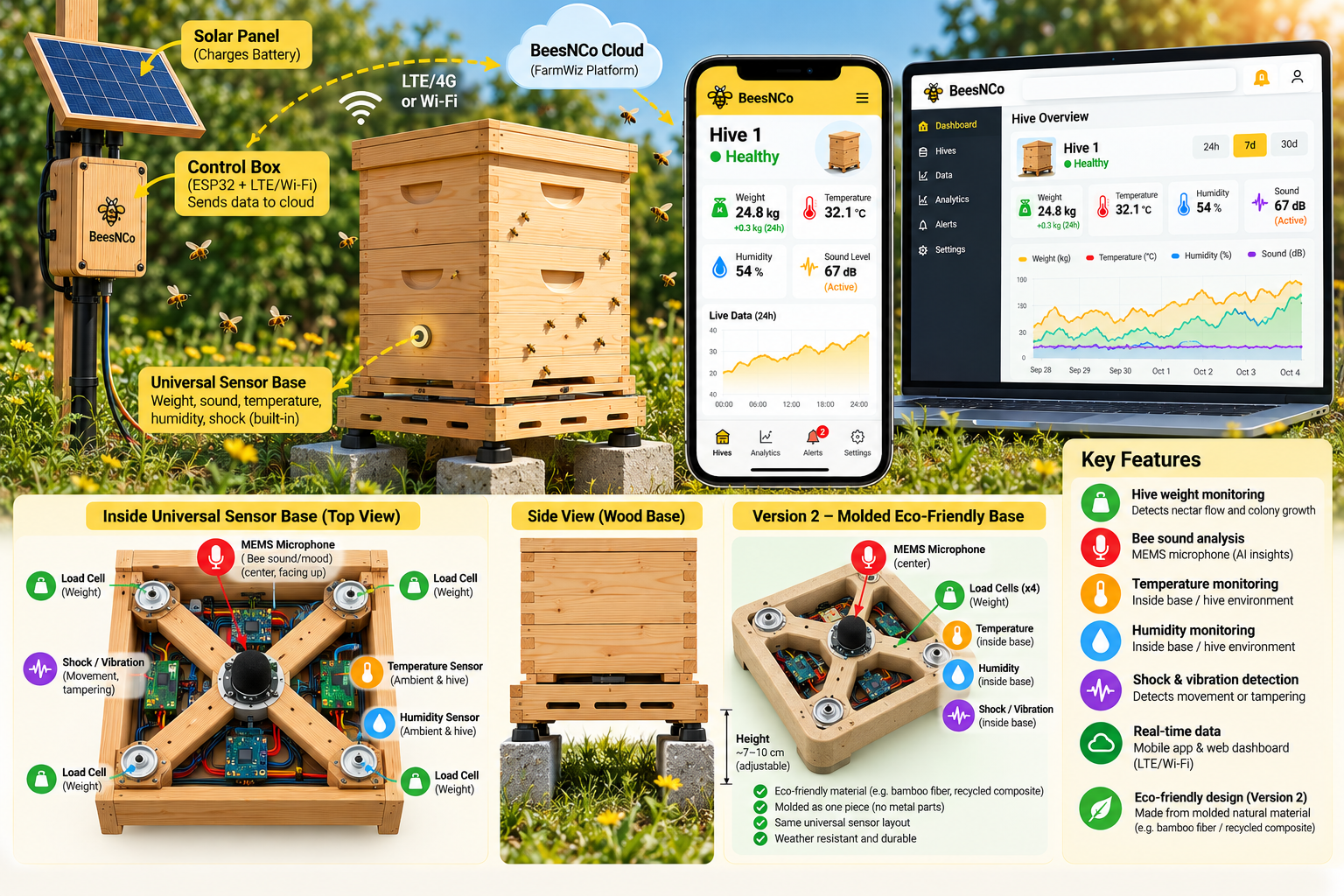
Our smart hive integrates cutting‑edge sensors to monitor colony health, detect theft, and track environmental conditions — all powered by solar energy and connected via LoRaWAN.
Our goal is to help young people understand bees as essential partners in food, biodiversity, and climate resilience. Through practical school workshops, students will observe bees up close, explore how pollination supports the food system, and discover how technology can help protect healthy hives and habitats.
Learn how bees live, communicate, pollinate plants, and contribute to the food on our tables.
Use safe observation activities and demonstrations to build respect for bees and confidence around hives.
See how smart-hive sensors capture temperature, sound, weight, and activity to support better decisions.
Identify local forage plants and design simple ideas for making school grounds more welcoming to pollinators.
Collect observations, ask questions, and turn local bee and flower activity into a small community science project.
Connect classroom learning with beekeepers, researchers, and community partners working for a healthier Suriname.
In this context, research means collecting reliable evidence about bees, other flower visitors, plants, and their environment. Pollinators are the animals that move pollen between flowers—mostly bees, but also butterflies, moths, flies, beetles, birds, and bats. Alongside our IoT deployment, Bees&Co connects sensor readings with field observations to show which pollinators visit which plants, when they appear, and how habitat and weather affect them.
A clear question, a repeatable method, local participation, useful data, and a practical conservation or livelihood outcome. A sensor is valuable when it helps answer a question—not simply because it produces data.
Build a baseline for Suriname’s coastal forests, mangroves, farms, and apiaries. Link flower visits and colony health to habitat protection, food production, climate resilience, and income for local communities.
Record the visitor, plant, location, date, time, and a photo of each flower visit.
Compare flowering, bee activity, rain, temperature, and hive weight across seasons.
Study weight, sound, humidity, temperature, flight activity, pests, and management actions.
Train beekeepers, students, and residents to collect observations with the same simple protocol.
The smart hive provides continuous measurements; field observations explain what is happening around the hive. Every record combines a consistent date, time, location, habitat, weather note, plant, visitor, photo where possible, and observer with the sensor data available for that period. Together, these streams create an evidence base for research partners and better conservation decisions.
Match field observations with hive weight, temperature, humidity, sound, and activity from the same period.
Record flowering plants and the bees, butterflies, flies, and other visitors using them.
Compare activity across seasons, weather conditions, apiaries, and coastal or agricultural habitats.
Use photos, repeat observations, expert review, and consistent data practices before drawing conclusions.
Share reports and recommendations that improve hive management and protect pollinator habitat.
As Bees&Co smart hives are deployed, the research track adds structured observations around selected apiaries and flowering habitats. The result is a growing baseline that connects colony conditions, local weather, forage availability, and pollinator activity—data that can be reviewed with scientific and conservation partners.
Our approach is informed by pollinator network monitoring and community-led biodiversity research. Bees&Co welcomes scientific and conservation partners to strengthen the work and interpret the results.
Today we watch. Tomorrow we automate. The future we export.
IoT monitoring: theft prevention, climate resilience, disease detection. 50 pilot hives across Suriname.
Automated ventilation, feeder systems, swarm prediction. 250 hives with predictive analytics.
Standardised quality analysis, blockchain traceability, direct‑to‑EU export partnerships.
EU traceability regulations require documented origin and residue controls. beesNco’s architecture ensures Suriname’s honey is export‑preferred. 🍯
Follow the latest beekeeping technology news, field work, and community updates.
See what Bees&Co is building and follow us for the newest updates from our IoT beekeeping work.
Open Bees&Co on Facebook →


Beekeepers & investors — let's build Suriname's honey future.